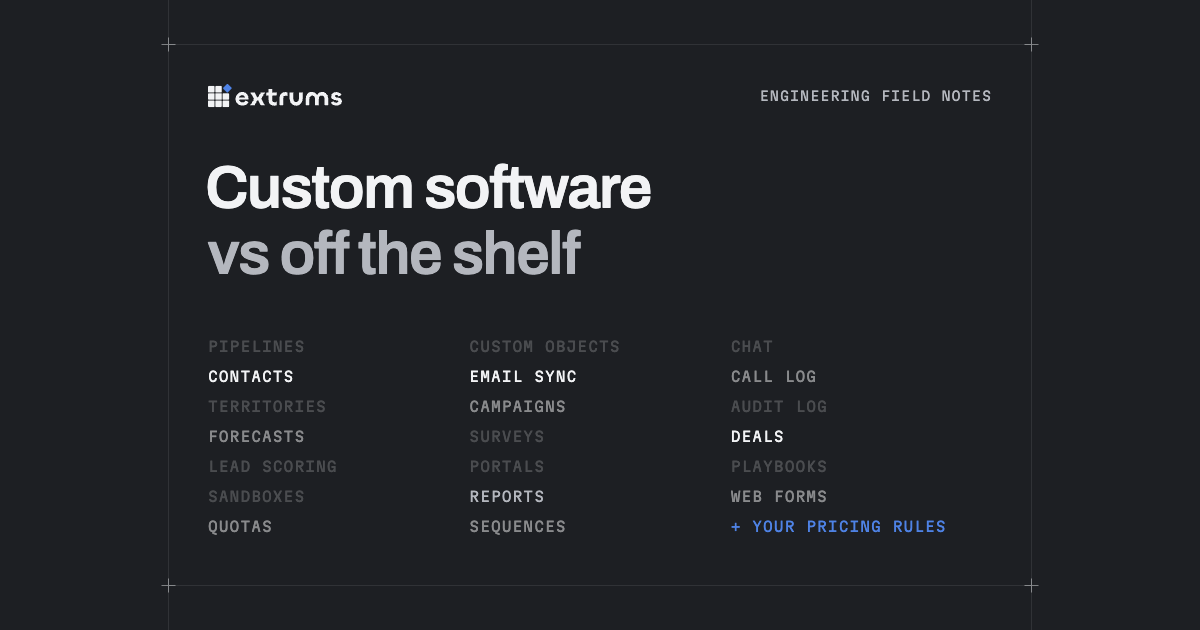
Short answer: buy when the process looks like everyone else's. Build when the process is how you win, or when the software you rent keeps forcing a workaround. Payroll, email and accounting get bought. The step that sets your prices, routes your orders or serves your customers is where custom software pays. AI made building cheaper, not free, so the line has moved.
For twenty years the advice here was simple: buy, unless you're big enough to keep a team of developers. A subscription cost less than an engineer, it worked on day one, and when it broke someone else fixed it.
Two things have shifted since. Subscriptions got more expensive and harder to leave. And writing code got cheaper, because engineers now hand a good part of it to AI models. Neither makes custom software the default. Both make the old rule worth checking again.
This note is for owners and managers of small and mid-sized businesses choosing a CRM, an order system or a booking tool. It covers what each option really costs, what AI changed and what it didn't, and a short test you can run on your own processes.
What is the difference between custom and off-the-shelf software?
Off-the-shelf software is built once and sold to many: Salesforce, QuickBooks, Shopify, the booking app your dentist uses. You rent it by the seat or by the month. It does what its makers decided most of their customers need.
Custom software (bespoke, in British English) is built for one business. You own the code, it follows your process exactly, and every change is yours to pay for.
Most businesses end up with both. So the useful question isn't which one to pick for the whole company. It's which one fits each process.
When is off-the-shelf software the right choice?
More often than development companies like to admit. Buy when:
The process is the same everywhere. Payroll, accounting, email, a help desk. No customer picks a supplier because of how its invoices are numbered.
The rules come from outside. Tax, payments, data protection. A vendor with thousands of customers tracks every change in the law for all of them at once.
You don't know yet how the process should work. A cheap tool you outgrow in a year teaches you what to build. Building first means guessing, and paying for the guess.
Nobody on your side will own the result. Custom software needs a person who knows why it works the way it does. Without one, it ages fast.
If none of your processes sets you apart, stop here and buy. That's a perfectly good answer.
What does off-the-shelf software really cost?
The list price is the smallest part. Three more costs arrive later.
Price rises at renewal. In Zylo's 2026 SaaS Management Index, 79% of IT leaders had met a price increase at renewal in the past twelve months. The longer you've used a tool, the more of your data and habits live in it, and the weaker your hand when the new price comes.
Seats nobody uses. The same index puts license utilization at 54% in 2025, up from 47% the year before. Put the other way round, close to half of the seats companies paid for sat idle. Zylo's data leans towards large organisations (the average one in it runs 305 SaaS applications and spends $55.7M a year on them), so a 20-person firm has fewer places to lose money. The habit is the same at any size, though: seats get added for a project and never removed.
Features you pay for and don't use. Pendo looked at usage across 615 customer subscriptions for its 2019 Feature Adoption Report and found that 80% of features were rarely or never used. Twelve percent of features carried 80% of daily use. A packaged product has to serve everyone, so most of what you buy is other people's requirements.
Then there's the cost nobody invoices: the workaround. The spreadsheet that fills the gap between two systems. The export every Monday. The person who copies orders from email into the CRM by hand. Off-the-shelf software is cheap when it fits — when it doesn't, you pay in hours.
What changed now that AI writes code?
Writing code got cheaper. A small internal tool that used to take a month of an engineer's time can now be ready in days, because much of the typing goes to a model. How much faster that really is depends on the work. We went through the studies in Is AI making developers faster?, and the short version is that the wait moves into review.
Companies have noticed. Retool surveyed 817 builders in late 2025, most of them its own customers. 35% had already replaced at least one SaaS tool with something they built, and 78% planned to build more in 2026. The categories most at risk, in their answers:
workflow automations, 35%
internal admin tools, 33%
BI tools, 29%
CRMs and form builders, 25%
Read those numbers with care. Retool sells a platform for building internal tools, and the people it asked are people who already build. Still, look at the list. These are the categories where a business's own process matters most and a packaged product helps least.
What didn't AI change?
Three things, and they decide most projects.
Knowing what to build. A model writes the code you describe. It can't tell you that your returns process has four exceptions nobody ever wrote down. Finding those takes someone sitting with the people who do the work.
Running it. Custom software needs hosting, updates, backups, security fixes and somebody to call when it breaks at 9 a.m. on a Monday. In the same Retool report, 26% of respondents named maintenance burdens as a blocker, and the report warns that time saved building can be lost again to maintenance.
Owning the decision. In August 2024 Klarna's CEO, Sebastian Siemiatkowski, told investors the company was shutting down Salesforce, and the story travelled as "AI replaces SaaS". In March 2025 he set it straight: "no, we did not replace SaaS with an LLM". Klarna had built an internal stack on Neo4j and other tools, and retired many of its systems, not all. That was a large fintech making a deliberate choice about its own data. It isn't a template for a 30-person company.
When does custom software pay off?
When at least one of these is true:
The process is how you win. The way you price, schedule, route or serve is the reason customers choose you. Squeezing it into a generic tool means working the way your competitors do.
You're paying for workarounds. Count the hours a week people spend moving data between systems by hand, and multiply by what those hours cost. That's the budget a custom piece competes with.
The seat bill grows faster than the business. Per-user pricing punishes adding people who need one screen, like a picker in the warehouse, a driver, a seasonal hire.
Your data matters more to you than to the vendor. Custom software keeps it in your own database, in a shape you chose. Moving it later is your call.
A person does a step AI could take over. Reading incoming orders, sorting requests, drafting the first reply. Packaged tools add AI features for their average customer; your own steps are yours to automate.
None of these is about the size of the company. A ten-person firm with one odd, valuable process has a better case for building than a large one with standard needs.
Can you combine custom and off-the-shelf software?
Usually that's the best answer. Keep the bought tools for what's standard, and build the piece that sits between them or on top of them.
In practice: accounting stays in the package your accountant already knows. Email and documents stay where they are. The one process that's yours (an order intake that reads emails and checks stock, a quoting tool with your pricing rules, a portal for your clients) gets built and connected to the rest through their APIs.
This keeps the custom part small, which is exactly where AI-assisted building is strongest. A focused tool with one clear job is quick to build, easy to review and cheap to run. A homemade replacement for an entire ERP is none of those things.
How do you decide for your own business?
Set aside an afternoon and go through your processes one at a time. For each, write down three answers:
Does it set you apart, or is it the same as everyone else's?
How many hours a week go into working around the current tool?
What will it cost to keep it as it is for the next year: the seats, the next renewal, those hours?
Standard processes that fit well: keep buying. Processes that set you apart and leak hours are the candidates. Start with the one that leaks the most, build it small, and give it three months before you build the next.
We can't give you a rule of thumb for how often building wins, and we'd be wary of anyone who quotes one. It depends on the process, and on who will look after the result.
If you'd like a second opinion before committing, that's our Consult step: a written judgment on where the project should go, and a document you keep whatever you decide. Or just write to us.
Common questions
What is off-the-shelf software?
Software made for a broad market and sold as it is, usually as a subscription: a CRM, an accounting package, an online store builder. You can configure it, but you don't change its code.
What are the pros and cons of custom software?
The pros: it fits your process, you own the code and the data, and there are no per-seat fees. The cons: you pay up front, someone has to maintain it, and the first version is only as good as your understanding of the process.
Is custom software worth it for a small business?
For the one or two processes that set the business apart, often yes, and AI has made those builds smaller. For everything else, rarely. A small business with ten custom systems has ten things to maintain.
Is SaaS the same as off-the-shelf software?
Most off-the-shelf software is sold as SaaS today, but some is still installed on your own machines. And custom software can run in the cloud too. The difference is who it's built for, not where it runs.